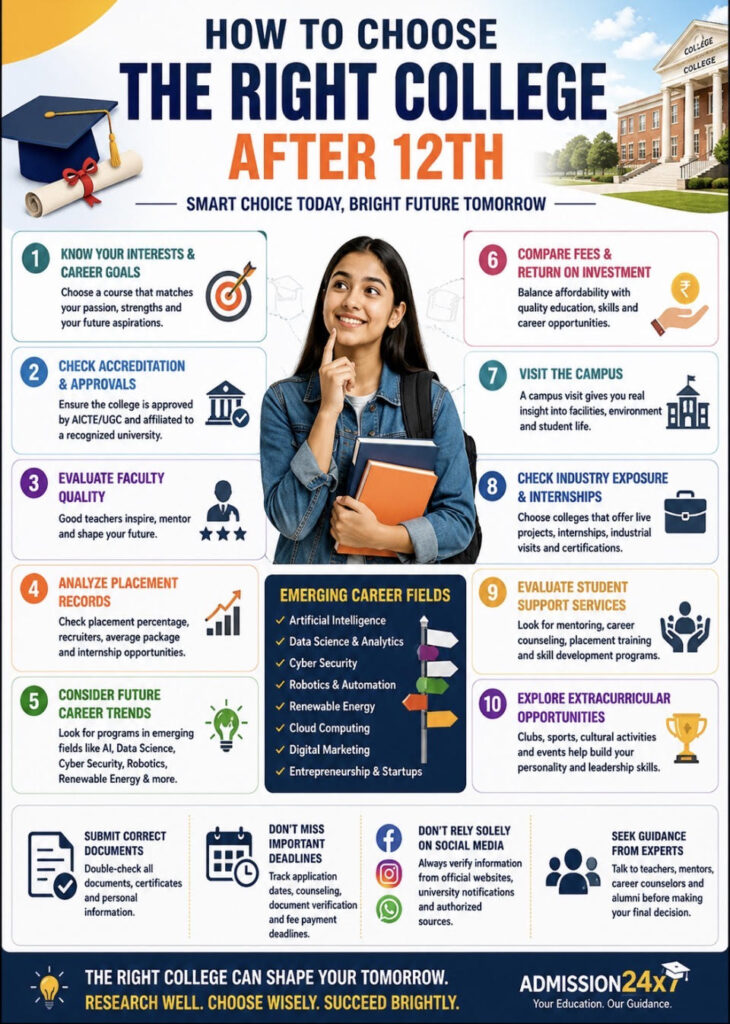
How to Choose the Right College After 12th: A Complete Guide for Students
Choosing the right college after Class 12 is one of the most important decisions in a student’s life. The college you select will influence your academic growth, skill development, career opportunities, professional network, and overall personality development. Every year, thousands of students make admission decisions based on advertisements, peer pressure, social media influence, or incomplete information, only to regret their choices later.
With hundreds of universities and colleges offering a wide range of courses, selecting the right institution can be challenging. Therefore, students and parents should adopt a systematic approach before making an admission decision.
This guide will help students understand the key factors to consider while choosing the right college after 12th.
1. Identify Your Interests and Career Goals
Before selecting a college, students should first understand their interests, strengths, and career aspirations.
Ask yourself:
- Which subjects do I enjoy studying?
- What are my strengths and skills?
- What kind of career do I want in the future?
- Do I want a job, higher studies, research, or entrepreneurship?
For example:
- Students interested in technology may explore Engineering, Artificial Intelligence, Data Science, or Cyber Security.
- Students interested in business and management may consider BBA, B.Com, Economics, or Entrepreneurship.
- Students interested in healthcare may explore Medical, Pharmacy, Biotechnology, or Allied Health Sciences.
Choosing a course that aligns with your interests increases motivation, academic performance, and career satisfaction.
2. Verify Accreditation and Approvals
One of the most important checks before admission is ensuring that the institution is properly recognized and accredited.
Students should verify:
- Approval from AICTE (for technical programs where applicable)
- Recognition by UGC
- Affiliation with a recognized university
- Accreditation by National Assessment and Accreditation Council
- Program accreditation by National Board of Accreditation where applicable
Accreditation ensures educational quality, academic standards, and degree recognition.
3. Evaluate Faculty Quality
Faculty members play a crucial role in shaping a student’s future.
Before taking admission, evaluate:
- Faculty qualifications
- Teaching experience
- Research contributions
- Industry exposure
- Student mentoring practices
Experienced faculty can provide valuable academic guidance, research opportunities, and career support.
4. Review Infrastructure and Learning Facilities
A quality learning environment significantly contributes to student success.
Check whether the college has:
- Well-equipped laboratories
- Modern classrooms
- Digital learning facilities
- Libraries and e-resources
- High-speed internet connectivity
- Innovation and incubation centers
- Sports and recreational facilities
Good infrastructure supports both academic and personal development.
5. Analyze Placement Records
Placement opportunities are often a major consideration for students and parents.
Evaluate:
- Placement percentage
- Average salary package
- Highest package
- Internship opportunities
- Industry collaborations
- Recruiter profiles
Do not rely only on marketing claims. Verify placement statistics through official reports, alumni feedback, and interactions with current students.
A strong placement ecosystem improves employability and career prospects.
6. Consider Future Career Trends
The world is changing rapidly due to technological advancements and digital transformation.
Students should consider programs related to emerging fields such as:
- Artificial Intelligence
- Data Science
- Cyber Security
- Robotics
- Renewable Energy
- Cloud Computing
- Internet of Things (IoT)
- Entrepreneurship
- Electric Vehicles (EV)
- Digital Marketing
Choosing future-oriented programs can provide long-term career advantages.
7. Compare Fees and Return on Investment
While affordability is important, students should not select a college solely because it has lower fees.
Instead, evaluate:
- Quality of education
- Placement opportunities
- Industry exposure
- Skill development programs
- Scholarship availability
Education should be viewed as an investment rather than merely an expense.
The goal is to maximize educational value and future career growth.
8. Visit the Campus
A campus visit provides firsthand information that websites and brochures cannot always convey.
During the visit, observe:
- Classroom environment
- Laboratory facilities
- Hostel conditions
- Library resources
- Campus cleanliness
- Security arrangements
- Student interactions
Speak with current students and faculty members whenever possible.
A campus visit helps students make informed decisions and avoid unpleasant surprises after admission.
9. Check Industry Exposure and Internship Opportunities
Modern employers seek practical skills in addition to academic knowledge.
Look for colleges that offer:
- Industrial visits
- Internships
- Live projects
- Industry certifications
- Guest lectures
- Workshops and seminars
Industry exposure helps students understand workplace expectations and enhances employability.
10. Evaluate Student Support Services
A good institution supports students beyond academics.
Important services include:
- Career counseling
- Mentorship programs
- Placement training
- Soft skills development
- Psychological counseling
- Entrepreneurship support
These services contribute to holistic student development.
11. Explore Extracurricular Activities
College life is not limited to academics.
Look for opportunities in:
- Sports
- Cultural activities
- Technical clubs
- Innovation competitions
- Entrepreneurship cells
- Community service
Participation in extracurricular activities helps develop leadership, teamwork, communication, and problem-solving skills.
12. Review Alumni Success Stories
Alumni achievements provide valuable insights into an institution’s effectiveness.
Research:
- Alumni career growth
- Higher education achievements
- Entrepreneurial success
- Leadership positions
Successful alumni often indicate a strong academic and professional ecosystem.
13. Avoid Common Admission Mistakes
Students should avoid:
- Choosing a college only by brand name
- Following peer pressure
- Ignoring personal interests
- Missing admission deadlines
- Relying solely on social media
- Overlooking placement records
- Ignoring accreditation and approvals
- Focusing only on low fees
- Submitting incorrect documents
- Skipping campus visits
- Ignoring future career trends
Making informed decisions reduces the risk of future dissatisfaction.
14. Consult Trusted Mentors and Career Counselors
Students should seek guidance from:
- Teachers
- Academic mentors
- Career counselors
- Industry professionals
- Parents and guardians
Professional guidance can help students evaluate options objectively and align educational choices with career goals.
15. Prepare a College Comparison Checklist
Before finalizing admission, compare shortlisted colleges based on:
| Parameter | College A | College B | College C |
|---|---|---|---|
| Accreditation | |||
| Faculty Quality | |||
| Infrastructure | |||
| Placements | |||
| Internships | |||
| Fees | |||
| Scholarships | |||
| Industry Exposure | |||
| Campus Facilities | |||
| Future Career Scope |
A structured comparison makes decision-making easier and more objective.
Conclusion
Choosing the right college after Class 12 is a critical decision that can shape your academic journey and future career. Students should focus on a combination of factors including academic quality, accreditation, faculty expertise, infrastructure, placement opportunities, industry exposure, affordability, and future career prospects.
Remember, the best college is not necessarily the most famous or the most expensive it is the institution that aligns with your interests, aspirations, learning style, and career goals.
A thoughtful and well-researched admission decision can lay the foundation for lifelong success, personal growth, and professional achievement.
Admission24x7.com is committed to helping students and parents make informed admission decisions by providing accurate guidance, expert insights, and up-to-date information about colleges, universities, courses, and career opportunities. Choose wisely today to build a brighter tomorrow.

Leave a Reply