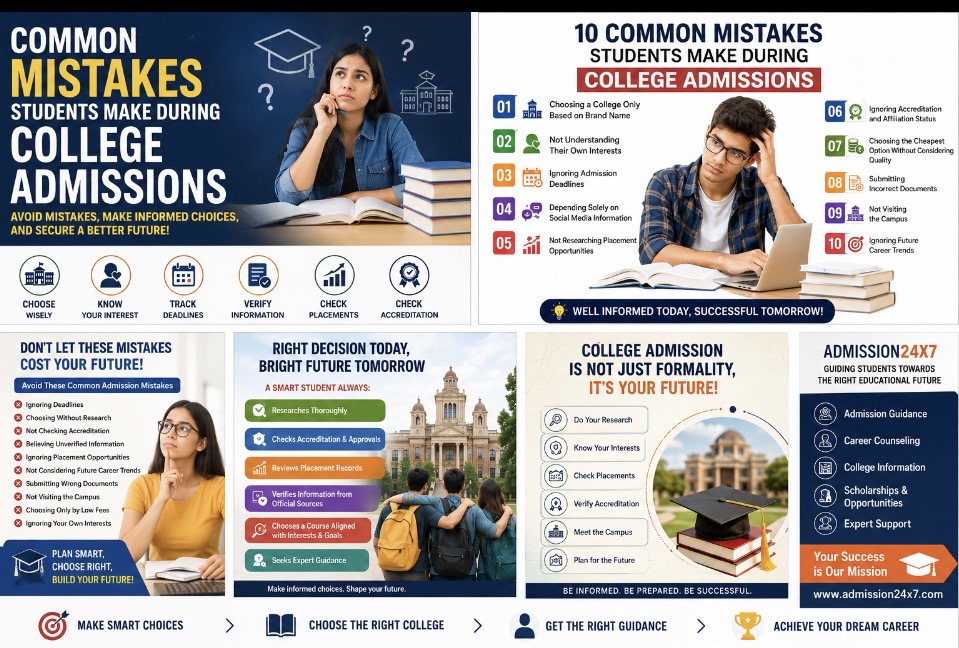
Every year, thousands of students miss valuable opportunities because of avoidable mistakes during the college admission process. Whether applying for B.Tech., MBA, MCA, BBA, BCA, or other professional programs, careful planning can help students secure admission to the right institution.
Key Mistakes to Avoid
1. Choosing a College Only by Brand Name
Many students and parents select a college simply because it is well-known or has a popular brand image. While a reputed name can be an advantage, it should not be the only factor in your decision. A college’s reputation does not always guarantee the best learning experience, placements, or career opportunities for every student. Before taking admission, students should carefully evaluate the following aspects:
✅ Accreditation and Approvals
Check whether the college is approved by relevant authorities such as AICTE, UGC, or affiliated with a recognized university. Accreditation ensures that the institution meets quality standards in education.
✅ Faculty Quality
Experienced and qualified faculty members play a crucial role in shaping a student’s academic and professional growth. Review faculty profiles, research contributions, and industry experience.
✅ Placement Records
Do not rely only on placement advertisements. Check actual placement statistics, average salary packages, top recruiters, internship opportunities, and alumni success stories.
✅ Infrastructure and Learning Resources
Modern laboratories, libraries, smart classrooms, research facilities, innovation centers, and a supportive learning environment contribute significantly to skill development.
✅ Industry Exposure
Look for colleges that offer industrial visits, live projects, internships, guest lectures by industry experts, entrepreneurship programs, and collaborations with companies.
2. Ignoring Personal Interests
One of the biggest mistakes students make during college admissions is choosing a course based on family expectations, friends’ choices, social trends, or market hype rather than their own interests and abilities.
✅ Research and Innovation Opportunities
For students interested in higher studies, innovation, or research, it is important to evaluate the institution’s research culture, publications, patents, funded projects, and innovation ecosystem.
A course may be popular or offer attractive salary packages, but if it does not match your interests and strengths, you may struggle academically and professionally in the future.
Why Personal Interests Matter
✅ Better Academic Performance
Students generally perform better in subjects they genuinely enjoy. Interest creates curiosity, motivation, and a willingness to learn beyond the classroom.
✅ Higher Career Satisfaction
A successful career is not only about earning money but also about enjoying your work. When your profession aligns with your interests, you are more likely to remain motivated and satisfied.
✅ Improved Skill Development
Students who are passionate about a field often invest extra time in learning, projects, certifications, internships, and research, which enhances their expertise.
✅ Reduced Stress and Frustration
Choosing a course under pressure can lead to dissatisfaction, poor performance, and even the desire to switch careers later. Selecting a field that matches your personality reduces such risks.
Common Examples
- A student interested in coding and technology may thrive in Computer Science, but may struggle if pushed into Civil or Mechanical Engineering only because of family preference.
- A student with strong communication and leadership skills may excel in Management, Marketing, or Entrepreneurship rather than a highly technical field.
- Someone passionate about design, creativity, or media should explore related career options instead of blindly following popular choices.
How to Choose the Right Course
✔ Identify your strengths and favorite subjects.
✔ Assess your skills, personality, and career goals.
✔ Research career opportunities in different fields.
✔ Seek guidance from teachers, mentors, and career counselors.
✔ Take aptitude and career assessment tests if required.
✔ Make a decision based on long-term career satisfaction rather than short-term trends.
Real-Life Perspective
Many professionals earn good salaries but are unhappy because they entered a field due to external pressure. On the other hand, people who follow their interests often achieve greater success because they remain committed, innovative, and enthusiastic throughout their careers.
3. Missing Important Deadlines
Missing admission-related deadlines is one of the most common and costly mistakes students make during the college admission process. Even highly qualified students can lose admission opportunities simply because they fail to submit forms, documents, or fees on time. Admission processes involve multiple stages, and each stage has a specific deadline that must be followed carefully.
Why Deadlines Are Important
✅ Application Submission Deadlines
Most colleges and universities have fixed dates for submitting admission applications. Missing the application deadline may result in losing the chance to apply altogether.
✅ Entrance Examination Dates
Students preparing for exams such as JEE, CUET, CAT, MAT, or university-specific entrance tests must keep track of registration and examination schedules.
✅ Counseling and Seat Allotment Rounds
After entrance exams, counseling rounds are conducted for seat allocation. Missing a counseling session can lead to cancellation of the allotted seat.
✅ Document Verification
Institutions require verification of academic certificates, identity proof, photographs, category certificates, domicile certificates, and other documents. Failure to complete verification within the specified timeline may result in admission rejection.
✅ Fee Payment Deadlines
Many students lose confirmed seats because they fail to deposit admission fees before the last date. Colleges generally do not extend fee submission deadlines.
Common Consequences of Missing Deadlines
- Loss of preferred college or course.
- Cancellation of allotted seats.
- Additional financial burden due to late applications.
- Increased stress and uncertainty.
- Having to wait for the next admission cycle.
Practical Tips to Avoid Missing Deadlines
✔ Create an admission calendar or checklist.
✔ Maintain a list of all colleges and universities you are applying to.
✔ Set reminders on your mobile phone and email.
✔ Keep all required documents ready in advance.
✔ Regularly visit official college and counseling websites.
✔ Check emails, SMS messages, and admission portal notifications daily.
✔ Complete submissions several days before the final deadline to avoid technical issues.
4. Relying Solely on Social Media
In today’s digital age, students often depend on social media platforms such as YouTube, Instagram, Facebook, WhatsApp groups, and Telegram channels for admission-related information. While these platforms can provide useful updates, relying solely on social media can lead to confusion, misinformation, and poor admission decisions.
Admission rules, eligibility criteria, fees, counseling schedules, and seat availability can change frequently. Information circulating on social media may be outdated, incomplete, or inaccurate.
Why This Is a Common Mistake
✅ Unverified Information
Anyone can post admission-related content on social media, but not everyone is an authorized source. Some posts may contain incorrect details regarding eligibility, fees, placements, or admission deadlines.
✅ Outdated Updates
Many videos and posts remain online for years. Students often follow old information without realizing that admission procedures, regulations, and policies have changed.
✅ Misleading Promotional Content
Some institutions or agents may highlight only positive aspects while hiding important details related to fees, placements, infrastructure, or approvals.
✅ Rumors and Speculation
WhatsApp groups and online forums often circulate rumors about counseling rounds, cutoffs, seat availability, or admission extensions that may not be officially confirmed.
Reliable Sources of Admission Information
✔ Official College Websites
Always check the college website for admission notifications, fee structures, eligibility criteria, infrastructure details, and placement records.
✔ University Websites and Notifications
Admission rules issued by universities and counseling authorities are the most authentic sources of information.
✔ Government and Regulatory Bodies
Information from organizations such as AICTE, UGC, and state counseling authorities should be considered trustworthy.
✔ Official Admission Helplines
Contact the admission office directly for clarification regarding admissions, scholarships, fee structures, and seat availability.
✔ Authorized Admission Portals
Use recognized and verified admission portals that provide accurate and updated information.
Example
A student sees a social media post claiming that admissions have been extended by two weeks. Trusting this information, the student delays applying. Later, they discover that the extension applied only to a different institution, and the deadline for their preferred college has already passed.
How to Verify Information
✔ Cross-check every important update with official sources.
✔ Visit the official website regularly.
✔ Download official admission brochures and notifications.
✔ Contact admission counselors or college representatives when in doubt.
✔ Verify placement statistics and approvals through authentic sources.
5. Overlooking Placement Records
One of the most critical mistakes students make while selecting a college is focusing only on admission, fees, infrastructure, or brand name while ignoring placement records. The ultimate goal of higher education is not only obtaining a degree but also building a successful career. Therefore, evaluating a college’s placement performance is essential before taking admission.
Many institutions advertise impressive placement figures, but students should carefully verify the actual placement data and career opportunities available.
Why Placement Records Matter
✅ Career Opportunities After Graduation
A strong placement ecosystem helps students secure jobs, internships, and industry exposure that can shape their future careers.
✅ Return on Educational Investment
Higher education requires significant investment of time and money. Good placement opportunities increase the likelihood of recovering this investment through better employment prospects.
✅ Industry Readiness
Colleges with strong placement support often focus on practical skills, industry projects, certifications, communication skills, and professional development.
Key Factors to Evaluate
1. Placement Statistics
Do not look only at the highest package advertised.
Instead, analyze:
✔ Placement percentage of eligible students.
✔ Average salary package.
✔ Median salary package.
✔ Number of students placed annually.
✔ Branch-wise placement performance.
A college may advertise a ₹50 LPA package received by one student, while the average package for most students may be significantly lower.
2. Recruiter Profiles
Check the quality and diversity of companies visiting the campus.
Look for recruiters from sectors such as:
- Information Technology
- Core Engineering
- Manufacturing
- Banking and Finance
- Consulting
- E-commerce
- Healthcare
- Research and Development
Regular participation from reputed companies indicates strong industry connections.
3. Internship Opportunities
Internships provide practical experience before graduation.
✔ Summer internships.
✔ Industry projects.
✔ Live assignments.
✔ Industrial training programs.
✔ Research internships.
A good institution should facilitate:
Students with internship experience generally have better placement outcomes.
4. Training and Career Support Services
Effective placement support includes:
✔ Aptitude training.
✔ Soft skills development.
✔ Communication skills enhancement.
✔ Resume building workshops.
✔ Mock interviews.
✔ Group discussion practice.
✔ Career counseling sessions.
These activities significantly improve employability.
5. Alumni Success Stories
Successful alumni often reflect the quality of education and career support provided by an institution.
Research:
- Alumni positions.
- Career progression.
- Entrepreneurial achievements.
- Higher education accomplishments.
6. Industry Collaborations
Colleges with industry partnerships often provide:
✔ Guest lectures by industry experts.
✔ Certification programs.
✔ Skill development workshops.
✔ Sponsored projects.
✔ Innovation and incubation support.
Such collaborations improve students’ industry readiness.
Common Mistake
Many students select a college because of attractive infrastructure, low fees, or marketing campaigns without reviewing actual placement outcomes. Later, they realize that placement opportunities are limited, affecting their career growth.
Questions Every Student Should Ask
What are the placement records for my specific branch?
6. Not Checking Accreditation & Approvals
One of the most serious mistakes students make during college admissions is failing to verify whether a college or its programs are properly approved, accredited, and recognized by the relevant regulatory authorities. Admission to an unapproved or poorly accredited institution can affect the value of your degree, placement opportunities, higher education prospects, and even eligibility for government jobs.
Before taking admission, every student should carefully verify the institution’s approvals and accreditation status.
Why Accreditation and Approvals Matter
✅ Degree Recognition
A degree from a properly recognized institution is widely accepted by employers, universities, government organizations, and professional bodies.
✅ Quality Assurance
Accreditation indicates that the institution meets established standards for teaching, infrastructure, faculty, research, governance, and student support.
✅ Better Career Opportunities
Many recruiters prefer graduates from accredited institutions because accreditation reflects educational quality and academic credibility.
✅ Eligibility for Higher Studies
Students planning to pursue postgraduate studies, research programs, or international education may face difficulties if their undergraduate institution lacks proper recognition.
1. AICTE Approval
For technical programs such as Engineering, Management, MCA, Pharmacy, and other professional courses, approval from the AICTE is extremely important.
AICTE approval ensures:
✔ Adequate infrastructure.
✔ Qualified faculty members.
✔ Laboratory and library facilities.
✔ Compliance with technical education standards.
✔ Student welfare and academic quality.
Students should always verify AICTE approval from official sources rather than relying solely on advertisements.
2. University Affiliation
A college must be affiliated with a recognized university that has the authority to award degrees.
Examples include:
- State Universities
- Central Universities
- Deemed Universities
- Private Universities established through legislative acts
Always verify:
✔ Affiliation status.
✔ Validity of affiliation for the current academic session.
✔ Recognition of the university itself.
A college without proper affiliation may create serious issues regarding degree validity.
3. NAAC Accreditation
The National Assessment and Accreditation Council evaluates and accredits higher education institutions based on academic quality and institutional performance.
NAAC assesses:
✔ Teaching and learning processes.
✔ Research activities.
✔ Infrastructure.
✔ Governance and leadership.
✔ Student support services.
✔ Innovation and best practices.
Institutions receive grades such as:
- A++
- A+
- A
- B++
- B+
- B
Generally, higher NAAC grades indicate stronger institutional quality.
4. NBA Accreditation
The National Board of Accreditation evaluates specific technical and professional programs rather than the entire institution.
NBA accreditation focuses on:
✔ Curriculum quality.
✔ Learning outcomes.
✔ Industry relevance.
✔ Faculty competence.
✔ Laboratory facilities.
✔ Graduate employability.
For engineering students, NBA-accredited programs often enjoy greater industry recognition and international acceptance.
5. Additional Recognition and Rankings
Students may also consider:
✔ Research output and patents.
✔ Industry collaborations.
✔ Innovation and incubation centers.
✔ Government-funded projects.
✔ National and international rankings.
However, these factors should complement—not replace—official approvals and accreditation.
Common Mistake
Some students get attracted by attractive advertisements, modern infrastructure, or low fees without checking whether the institution has proper approvals. Later, they face challenges related to placements, higher education admissions, or degree recognition.
Questions Every Student Should Ask
Can the degree be used for higher education and government employment?
7. Focusing Only on Low Fees
Many students and parents consider tuition fees as the primary factor while selecting a college. While affordability is undoubtedly important, choosing a college solely because it has the lowest fees can be a costly mistake in the long run. The real value of higher education lies not only in what you pay today but also in the knowledge, skills, opportunities, and career growth you gain in the future.
A low-fee college may seem attractive initially, but if it lacks quality education, experienced faculty, industry exposure, and placement support, students may face challenges in building a successful career.
Why Low Fees Should Not Be the Only Criterion
✅ Education is an Investment, Not Just an Expense
Higher education should be viewed as an investment in your future. A college that provides quality education, practical training, and strong placement opportunities can offer better returns over time.
✅ Skill Development Matters More Than Fees
Employers hire candidates based on their skills, knowledge, and industry readiness. Colleges that provide hands-on learning, certifications, internships, and project-based education often help students become more employable.
✅ Better Career Opportunities
A slightly higher fee may be justified if the institution offers strong placement records, industry collaborations, entrepreneurship support, and career development programs.
Factors to Evaluate Along with Fees
1. Academic Quality
Before comparing fees, examine:
✔ Faculty qualifications and experience.
✔ Student-faculty ratio.
✔ Teaching methodology.
✔ Laboratory and research facilities.
✔ Academic performance and outcomes.
2. Placement Support
A college with higher fees but excellent placements may provide much better career opportunities than a low-cost institution with weak placement records.
Check:
✔ Placement percentage.
✔ Average salary packages.
✔ Recruiter profiles.
✔ Internship opportunities.
3. Infrastructure and Learning Resources
Quality infrastructure enhances learning.
Consider:
✔ Modern laboratories.
✔ Libraries and digital resources.
✔ Computer centers.
✔ Innovation and incubation facilities.
✔ Campus environment.
4. Industry Exposure
Look for colleges that provide:
✔ Industrial visits.
✔ Live projects.
✔ Internships.
✔ Guest lectures.
✔ Industry certifications.
These experiences significantly improve employability.
5. Student Support Services
A good institution should offer:
✔ Career counseling.
✔ Mentoring programs.
✔ Skill development training.
✔ Entrepreneurship support.
✔ Personality development initiatives.
Consider Scholarships and Financial Assistance
If affordability is a concern, students should explore:
✔ Government scholarships.
✔ Merit-based scholarships.
✔ Need-based financial assistance.
✔ Education loans.
✔ Fee waivers and concessions.
Sometimes a better institution becomes affordable through financial support programs.
Example
A student chooses a college solely because the annual fee is very low. After graduation, the student discovers that the institution has limited placement opportunities and weak industry connections. Another student pays slightly higher fees at a quality institution, gains internships, industry exposure, and secures a good job placement. Over time, the second student receives a much greater return on the educational investment.
Common Mistake
Many students compare colleges only on the basis of annual fees without considering academic quality, placements, faculty expertise, infrastructure, and career outcomes. This short-term approach can limit future opportunities.
Questions Every Student Should Ask
What are the long-term career prospects after graduation?
8. Submitting Incorrect Documents
One of the most overlooked yet critical mistakes during the college admission process is submitting incorrect, incomplete, or mismatched documents. Even if a student meets all eligibility requirements and performs well academically, admission can be delayed, cancelled, or rejected due to document-related errors.
Admission authorities carefully verify every document to ensure the authenticity of a candidate’s academic and personal information. Therefore, students must review all documents thoroughly before submission.
Why Document Accuracy Matters
✅ Verification of Eligibility
Colleges use submitted documents to confirm that applicants meet the required educational qualifications, age criteria, and other admission requirements.
✅ Prevention of Admission Delays
Incorrect or incomplete documents often lead to repeated verification requests, causing delays in counseling, seat allotment, and admission confirmation.
✅ Avoidance of Admission Cancellation
Providing incorrect information, intentionally or unintentionally, may result in rejection of the application or cancellation of admission at a later stage.
Common Document-Related Mistakes
1. Incorrect Personal Information
Students sometimes enter:
❌ Wrong spelling of their name.
❌ Incorrect date of birth.
❌ Wrong parent or guardian details.
❌ Incorrect address, email, or mobile number.
Such errors can create problems during verification and future academic records.
2. Uploading Wrong Documents
Examples include:
❌ Uploading an incorrect mark sheet.
❌ Submitting another person’s certificate by mistake.
❌ Uploading old or expired documents.
❌ Uploading unclear or incomplete scanned copies.
Always verify each uploaded file before final submission.
3. Mismatch Between Documents
A common issue occurs when details differ across documents.
Examples:
- Different spelling of the student’s name.
- Different dates of birth.
- Variations in parent names.
- Inconsistent category information.
Any mismatch may require additional affidavits or correction procedures.
4. Poor Quality Scanned Copies
Documents should be:
✔ Clear and readable.
✔ Properly scanned.
✔ Complete without cropped sections.
✔ Uploaded in the prescribed format and size.
Blurred documents often lead to rejection during online verification.
5. Missing Mandatory Documents
Students sometimes forget to submit essential documents such as:
✔ Class 10 Mark Sheet and Certificate.
✔ Class 12 Mark Sheet and Certificate.
✔ Graduation Marksheets (for PG admissions).
✔ Transfer Certificate (TC).
✔ Migration Certificate.
✔ Character Certificate.
✔ Category Certificate (if applicable).
✔ Domicile Certificate (if applicable).
✔ Aadhaar Card or Identity Proof.
✔ Passport-size Photographs.
Document Checklist Before Submission
Before clicking the final submit button, verify:
✔ Name matches across all documents.
✔ Date of birth is correct.
✔ Academic records are complete.
✔ Category and domicile certificates are valid.
✔ Photographs meet prescribed specifications.
✔ Documents are scanned clearly.
✔ File sizes and formats meet requirements.
✔ Contact details are accurate and active.
Example
A student qualifies for admission and receives seat allotment. During document verification, officials discover that the name on the Class 12 certificate differs from the name entered in the application form. The student must then undergo a lengthy correction process, risking delays or even loss of admission.
Practical Tips
✔ Keep both original and photocopied documents ready.
✔ Create a digital folder containing scanned copies of all certificates.
✔ Read admission instructions carefully.
✔ Verify every uploaded document before submission.
✔ Ask a parent, teacher, or counselor to cross-check your application form.
Key Takeaway
“A small mistake in documentation can lead to major admission problems. Always double-check your certificates, photographs, personal details, and uploaded files before submitting any application.”
Careful document verification ensures a smooth admission process and helps students avoid unnecessary stress, delays, and complications.—
Conclusion
College admission is one of the most important milestones in a student’s academic journey. By avoiding these common mistakes—choosing a college only by brand name, ignoring personal interests, missing deadlines, relying solely on social media, overlooking placement records, neglecting accreditation checks, focusing only on low fees, and submitting incorrect documents—students can make informed decisions and secure admission to institutions that truly support their educational and career goals.
9. Skipping Campus Visits
In the digital era, students can access college brochures, websites, virtual tours, and social media content with just a few clicks. However, many students make the mistake of finalizing their college choice without ever visiting the campus. While online information is helpful, it cannot fully replace the experience of seeing the institution in person.
A campus visit allows students and parents to evaluate the college environment, interact with faculty and students, and gain a realistic understanding of what the institution offers beyond promotional materials
Why Campus Visits Are Important
✅ Firsthand Experience of the Campus Environment
A college may appear impressive in advertisements and brochures, but an actual visit helps students understand the real atmosphere, cleanliness, discipline, and overall campus culture.
✅ Better Decision-Making
Visiting the campus helps students compare institutions more effectively and choose the one that best matches their academic and personal goals.
✅ Verification of Information
Students can verify whether the facilities, laboratories, classrooms, libraries, and infrastructure shown online actually exist and are functioning properly.
Key Areas to Observe During a Campus Visit
1. Academic Infrastructure
Check:
✔ Classrooms and smart learning facilities.
✔ Laboratories and practical training facilities.
✔ Computer centers and internet connectivity.
✔ Library resources and digital learning platforms.
✔ Research and innovation facilities.
A strong academic environment directly contributes to student learning and development.
2. Faculty Interaction
Try to interact with faculty members and department representatives.
Ask questions such as:
- What teaching methodologies are used?
- What research opportunities are available?
- How are students mentored?
- What industry collaborations exist?
Faculty interaction often provides valuable insights beyond marketing presentations.
3. Placement and Career Development Facilities
Visit:
✔ Training and Placement Cell.
✔ Career Development Center.
✔ Entrepreneurship and Innovation Centers.
✔ Incubation and Startup Support Facilities.
Understanding the college’s commitment to student careers is essential.
4. Hostel and Residential Facilities
If you plan to stay on campus, evaluate:
✔ Hostel rooms.
✔ Dining facilities.
✔ Hygiene standards.
✔ Security arrangements.
✔ Recreational facilities.Comfortable living conditions significantly impact student well-being and academic performance.
5. Campus Safety and Security
Observe:
✔ Security personnel.
✔ CCTV surveillance.
✔ Emergency response systems.
✔ Anti-ragging measures.
✔ Student grievance mechanisms.
A safe campus environment is crucial for students and parents alike.
6. Student Life and Campus Culture
Interact with current students to learn about:
✔ Academic workload.
✔ Faculty support.
✔ Clubs and societies.
✔ Sports and cultural activities.
✔ Student satisfaction levels.
Current students often provide the most honest feedback about the institution.
7. Location and Accessibility
Consider:
✔ Transportation facilities.
✔ Connectivity to nearby cities.
✔ Medical facilities nearby.
✔ Availability of essential services.
Practical aspects can significantly affect daily student life.
Questions to Ask During a Campus Visit
✔ What are the placement records for my course?
✔ What internship opportunities are available?
✔ How are industry interactions conducted?
✔ What scholarships and financial aid options exist?
✔ What student support services are provided?
✔ What extracurricular activities are available?
Common Mistake
Many students choose colleges based solely on websites, advertisements, rankings, or recommendations from friends. After admission, they discover that the actual campus environment, facilities, or academic culture does not meet their expectations.
Example
A student compares two colleges with similar fees and placement records. After visiting both campuses, the student realizes that one institution offers better laboratories, more active student clubs, stronger industry interactions, and a more supportive learning environment. The campus visit helps the student make a more informed and confident decision.
Benefits of a Campus Visit
✔ Realistic understanding of facilities.
✔ Direct interaction with faculty and students.
✔ Verification of claims made in advertisements.
✔ Better assessment of campus culture.
✔ Greater confidence in admission decisions.
10. Ignoring Future Career Trends
One of the most important yet often overlooked aspects of college admissions is considering future career opportunities. Many students choose courses based only on current popularity, family suggestions, or traditional career paths without analyzing how industries and job markets are evolving.
The world of work is changing rapidly due to technological advancements, automation, digital transformation, sustainability initiatives, and globalization. Students who align their education with future industry demands are more likely to enjoy better career growth, employability, and entrepreneurial opportunities.
Why Future Career Trends Matter
✅ Better Employment Opportunities
Industries are continuously evolving, and new job roles are emerging every year. Students who develop skills relevant to future markets gain a competitive advantage.
✅ Higher Demand and Better Salaries
Emerging sectors often experience talent shortages, creating attractive job opportunities and competitive salary packages for qualified professionals.
✅ Adaptability to Technological Changes
Future-focused education helps students stay relevant in a rapidly changing professional environment.
✅ Long-Term Career Growth
Choosing a field with strong future prospects increases the likelihood of sustained career success and advancement.
Emerging Career Fields to Consider
1. Artificial Intelligence (AI) and Machine Learning
AI is transforming industries such as healthcare, finance, manufacturing, education, transportation, and e-commerce.
Career opportunities include:
✔ AI Engineer
✔ Machine Learning Specialist
✔ AI Research Scientist
✔ Data Analyst
✔ AI Product Manager
As AI adoption grows worldwide, demand for skilled professionals continues to increase.
2. Data Science and Analytics
Data has become one of the most valuable assets for organizations.
Career roles include:
✔ Data Scientist
✔ Business Analyst
✔ Data Engineer
✔ Data Visualization Expert
✔ Predictive Analytics Specialist
Organizations increasingly rely on data-driven decision-making, making this field highly attractive.
3. Cyber Security
With growing digitalization, protecting information systems has become a critical priority.
Career options include:
✔ Cyber Security Analyst
✔ Ethical Hacker
✔ Security Consultant
✔ Information Security Manager
✔ Digital Forensics Expert
Governments, corporations, and financial institutions require cybersecurity professionals to safeguard digital assets.
4. Robotics and Automation
Automation is revolutionizing manufacturing, healthcare, logistics, and smart industries.
Career opportunities:
✔ Robotics Engineer
✔ Automation Specialist
✔ Mechatronics Engineer
✔ Industrial Automation Expert
✔ Robotics Programmer
Industry 4.0 initiatives are creating substantial demand for these skills.
5. Renewable Energy and Sustainability
Global efforts toward environmental sustainability have increased demand for professionals in clean energy sectors.
Career opportunities:
✔ Solar Energy Engineer
✔ Wind Energy Specialist
✔ Sustainability Consultant
✔ Environmental Analyst
✔ Green Technology Expert
The transition to renewable energy is expected to generate significant employment opportunities worldwide.
6. Entrepreneurship and Startups
Many students are now creating their own ventures rather than pursuing traditional jobs.
Important entrepreneurial skills include:
✔ Business Planning
✔ Innovation Management
✔ Financial Literacy
✔ Leadership Skills
✔ Digital Marketing
Institutions with innovation centers, startup incubation facilities, and entrepreneurship programs can help students become job creators instead of job seekers.
Additional High-Growth Areas
Students may also explore:
✔ Cloud Computing
✔ Internet of Things (IoT)
✔ Blockchain Technology
✔ FinTech
✔ Digital Marketing
✔ Biotechnology
✔ Healthcare Technology
✔ Electric Vehicles (EVs)
✔ Augmented Reality (AR) and Virtual Reality (VR)
How Students Can Prepare
✔ Choose future-oriented academic programs.
✔ Develop digital and technical skills.
✔ Earn industry-recognized certifications.
✔ Participate in internships and live projects.
✔ Engage in research and innovation activities.
✔ Stay updated with technological advancements.
✔ Build problem-solving and critical-thinking abilities.
Common Mistake
Many students select a course solely because it has traditionally been popular or because friends are choosing it. Without understanding future industry requirements, they may graduate with skills that are less relevant in the evolving job market.
Example
A student interested in technology chooses a program that includes Artificial Intelligence, Data Science, and Cloud Computing electives. During college, the student completes certifications, internships, and projects in these areas. Upon graduation, the student is better prepared for emerging job opportunities than peers who focused only on traditional coursework.
Key Takeaway
“Choose a course not only for today’s opportunities but also for tomorrow’s possibilities. Understanding future career trends helps students make informed educational choices and prepare for a rapidly changing professional world.”
Successful careers are built by combining personal interests, quality education, skill development, and awareness of future industry demands.
By considering emerging fields such as AI, Data Science, Cyber Security, Robotics, Renewable Energy, and Entrepreneurship, students can position themselves for long-term growth and success.
Final Thoughts
College admission is a crucial decision that can shape a student’s academic and professional future. Research thoroughly, seek expert guidance, and choose institutions that align with your goals and aspirations.
About Admission24x7
Admission24x7 is dedicated to providing authentic admission information, career guidance, counselling support, and educational opportunities to students across India.
Author: Dr. Bipin Kumar Srivastava
Professor | Researcher | Innovation Ambassador | Educational Mentor
Copyright & Disclaimer
© 2026 Admission24x7. All Rights Reserved.
This article is intended for educational and informational purposes only. Admission policies, eligibility criteria, fee structures, and approval status may change from time to time. Readers are advised to verify information from the respective institution’s official sources before making admission-related decisions. Unauthorized reproduction, copying, or distribution of this content without prior written permission from Admission24x7 is prohibited.

Leave a Reply